
Take a moment.
Breathe in.
Breathe out.
Today is a big day.
It’s Good Friday, and Jesus will die.
That’s the story we remember and we relive each year as we seek to sync our life to the life of Christ. We journey from the anticipation of Advent to the arrival of Christmas, from the ecstasy of Epiphany to the mundanity of Ordinary Time and Jesus’s teachings that govern everyday living, from the purposeful preparation of Lent to the palm-waving celebration of Palm Sunday to the roller-coaster of emotions that is Maundy Thursday…… and now today.
Breathe in.
Breathe out.
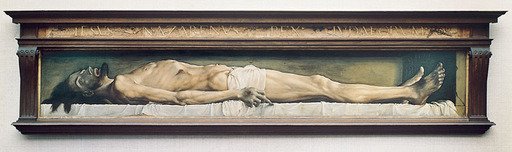
Tonight we provide the opportunity to pray through the Scriptural Stations of the Cross as a way of remembering and embodying the story of Jesus’s death. With each Station is an accompanying piece of artwork to provide a contemplative focus.
The fourteenth and final image is titled “The Body of the Dead Christ in the Tomb,” painted by Hans Holbein. It is this image, in August of 1867, that Russian writer Fyodor Dostoevsky found himself standing before at a museum in Basel, Switzerland, unable to look away. Dostoevsky’s wife, Anna Grigorievna, wrote of its portrayal and said: “The painting made an overwhelming impression on my husband, and he stood before it as if dumbstruck.”
So deeply did Holbein’s painting impact Dostoevsky that he worked it into “The Idiot.” In that novel, published in serialized form, the protagonist Prince Myshkin also travels to Basel and sees the painting. While discussing the painting, another character asks Myshkin, “Do you believe in God?” Myshkin initially replies, “A man could … lose his faith from that painting!” He then tells a series of stories that seem to illustrate the depravity of humanity before landing on one about a woman making the sign of the cross with great piety when her six-week-old infant smiles at her for the first time. Myshkin asks her why she has done so, and she replies: “It’s just that a mother rejoices when she notices her baby’s first smile, exactly the same as God rejoices each time he looks down from heaven and sees a sinner standing before him and praying with all his heart.”
Myshkin continues: “This is what that poor woman said to me, almost word for word; and such a deep, refined, truly religious thought it was — a thought in which the whole essence of Christianity was expressed in one flash—that is, the recognition of God as our Father, and of God’s joy in men as His own children, which is the chief idea of Christ.”
It’s not just Myshkin asserting as such. These conclusions are the result of Dostoevsky’s own wrestling with that same image over months and months. The painting challenges because few of us really consider the reality of a dead Jesus. But perhaps as proves to be the case for Myshkin (and Dostoevsky), the truth of Jesus’s death only makes the resurrection of Easter that much sweeter.
Take a moment.
Breathe in.
Breathe out.
We’re all in this together,
Pastor Michael