
On Sunday, we reflected on truth and lies, considering in particular how truth endures no matter our attempts at twisting, distorting, or spinning it into something else… or our attempts to deny it completely. Jesus, as we saw and read clearly from Luke 8:17, insists that all those hidden machinations that are required to support a network of lies will be exposed: “For nothing is hidden that will not be disclosed, nor is anything secret that will not become known and come to light.” (NRSVue)
And how curious, it seems to me — how just like the Spirit — for me to come across a seemingly-innocuous illustration of manipulative deception just this week… an attempt to disguise origins, deceive and distort and diminish one’s perspective of another, and all to make a profit by selling bibles. That’s right. I said “bibles.”
You’ll not be surprised to learn that I am a member of one (or more) bible groups on Facebook. I use these to stay current about new translations and publications. Mostly I do not participate in discussion because there are too many self-credentialed experts.
Here’s the image.
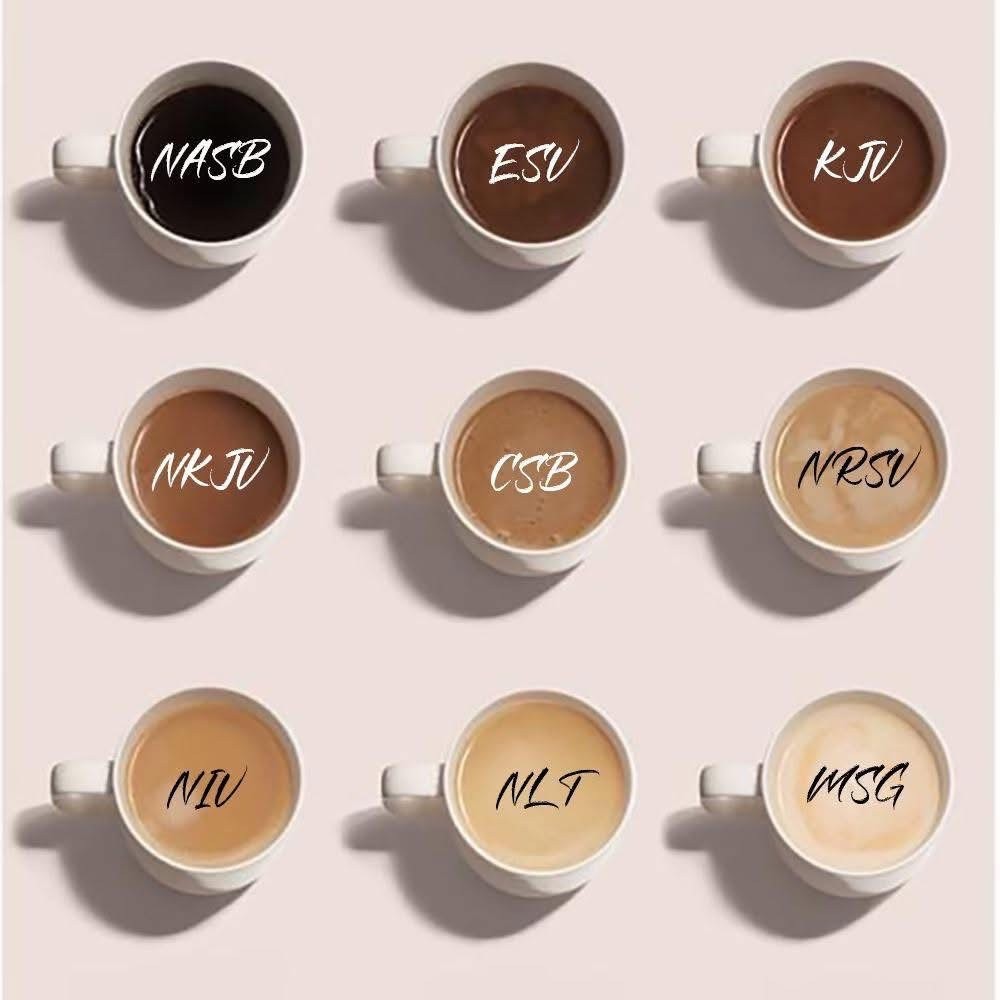
Each of these cups of coffee indicates a bible translation. Starting from the upper left, these are the: New American Standard Bible, the English Standard Version, the King James Version, the New King James Version, the Christian Standard Bible, the New Revised Standard Version, the New International Version, the New Living Translation, and The Message. I have admitted that this image seems innocuous. But look with me beneath the surface.
First, consider the symbolism of coffee itself: dark and light, pure and watered down, strong and weak, masculine and feminine… I’m not saying these symbols SHOULD be coded into our coffee consumption; I’m simply acknowledging that they ARE coded as such. By transferring these symbols onto particular bible translations, what does that communicate about them, their worth, and whether you should use them?
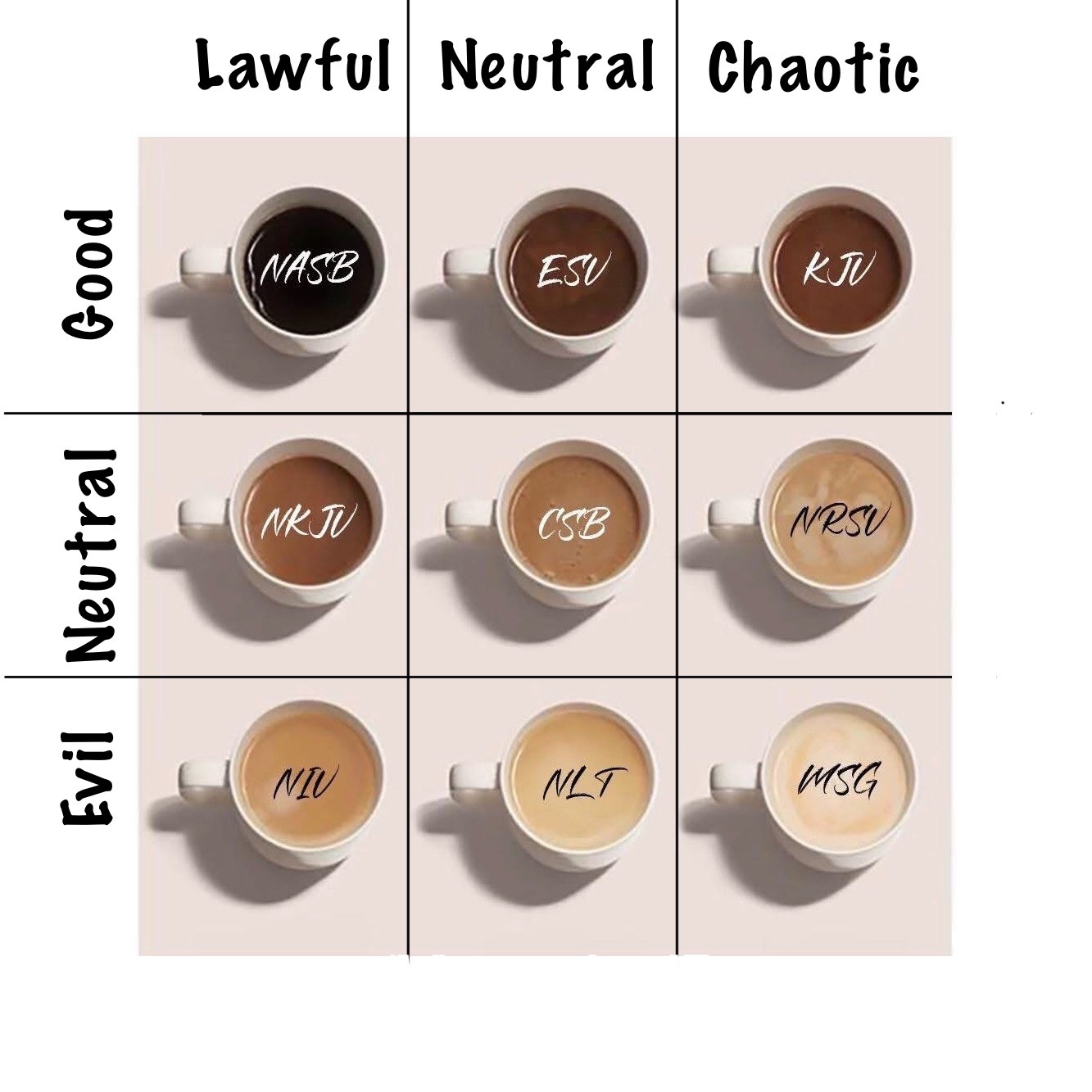
For some — especially younger folks and a certain kind of nerd (like me), a series of nine boxes arranged as such immediately evokes a template of orientation used in tabletop RPGs, and which has spilled over into memes. Layered over the coffee image, the polarities of good vs. evil and lawful vs. chaotic look like the following. What does this imply about certain translations?
Then there’s position. These are obviously laid out in a spectrum from black coffee to heaviest cream and with a clear center focus. That center translation, the Christian Standard Bible, is a VERY slight revision of the Holman Christian Standard Bible. When the revision came out, I remarked to a fellow bible nerd that the biggest change seemed to be the name. And indeed, it seems that was truly the purpose.
The Holman Christian Standard Bible (HCSB) was commissioned by the Southern Baptist Churches (SBC) to be produced by the SBC for one express purpose: so the SBC could stop paying royalties to use the NIV in its publications. The translation was named after the primary publishing company of the SBC, Broadman and Holman. Once they had the translation to use, the SBC realized they had a chance to make good profit off of bible sales and to get other people to pay royalties to them the way they paid royalties for the NIV. But people saw the HCSB as a SBC translation, so not many bibles were sold outside of the SBC, and other denominations publishing houses were unwilling to use a translation with such an explicitly denominational focus. Dropping the “H” distanced the translation from the denomination enough that people didn’t know where it came from. Suddenly — by hiding its origins — they had a cash cow.
No one trying to sell the Message would put together this graphic, nor the NRSV, ESV, NKJV, or any of the other translations. It was fabricated to purposefully misrepresent other bible translations in order to sell more copies of a translation that would NOT sell without hiding its origins — those who produced it.
I know this deceit isn’t reflective of Community Baptist’s spirit, but this is still the “Christianity” the world is encountering. And that makes the importance of living out lives committed to truth that much more important and that much more “Christian.”
Remember, we’re all in this together,
Pastor Michael